
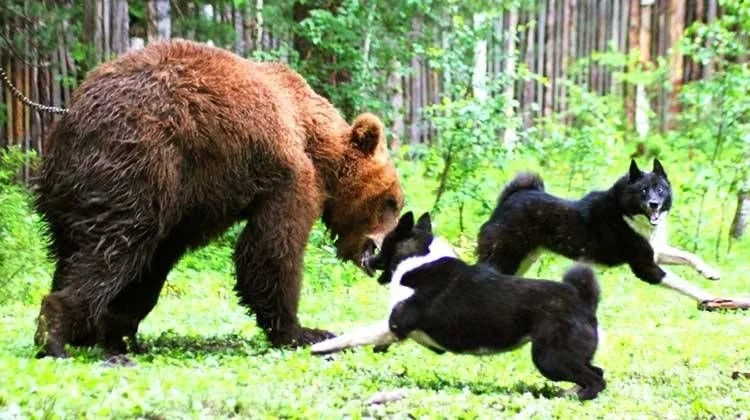
ABOVE: Karelian Bear dogs shepherding a bear
Dogs and bears
keep dogs on leash for safety
We love dogs and all pets – and many of us share our homes with at least one furry companion. However, off-leash dogs can be the cause of conflict with wildlife. Wildlife can see a dog as a predator, or at the very least, a threat and occasionally even as a meal. It may be necessary to let your dog go, for your own safety, on steep or treacherous trails, but please be aware of the risks. Research the presence of local wildlife, respect signage and local bylaws. Bears often frequent particular areas at different times of the season; talk to your friends, neighbours and fellow trail users about bear sightings, watch for signage and avoid those areas until the animals have moved on. Please avoid walking your dogs, especially off leash, when moms with cubs are known to be in the area. When in the woods with your dog, even on leash, it is a very good idea to bring bear spray. ALWAYS WALK YOUR DOG ON LEASH WHEN THERE ARE BEARS REPORTED TO BE IN THE AREA; AVOID AREAS WITH GRIZZLIES! When making the decision to get a new companion dog, please put time and effort into training. Work with your dog to develop strong recall and good social skills.
It is healthy and rewarding to walk in nature, but please do it safely - for yourselves, your pets and for the wildlife.
Dogs + wildlife = Increased possibility of conflict
The number of hikers and dogs on our trails has been growing and increasing stress on local wildlife.
Bears may become stressed by the mere presence of dogs. Although many bears learn to cope peacefully, some individuals can feel provoked by the mere presence of a dog, even a small one. The increased pressure of being chased by a dog, escalates the potential risk to your pet as well as yourself, while the bear defends itself, its cubs or a food source.
“Are dogs “saviours” or are they contributing factors in black bear attacks on people?” “Is a dog help or hindrance in bear country?”
There have been occasional accounts of dogs surprising, chasing, harassing and/or cornering a bear, when upon return, the bear has chased the dog back to their person, creating a very volatile situation.
Tiny cubs of the year can become traumatized when harassed by well fed off leash dogs. Black bear moms seldomly, but can cause injury in defence of cubs. Protective grizzly bear moms are responsible for 50% of injuries in NA.
During hyperphagia, prior to denning, bears are intently focused on gaining fat reserves. At this crucial time, being chased, harassed and stressed by off leash dogs can cause bears to abandon feeding. Calories and the energy necessary to survive the winter are lost and wasted.
DOGS FOR PROTECTION The use of dogs, especially guardian animals, can be effective for protecting livestock, crops and yards, however any attractants, including garbage and compost can still bring a bear into your property. If your dog chases a bear inside your yard and blocks its escape route, it risks severe injury. The added protection of deterrents like electric fencing and alarm devices will help keep hungry bears at bay and provide more safety for your dog. A backyard full of garbage, compost and other attractants puts your property, pets and family at risk.
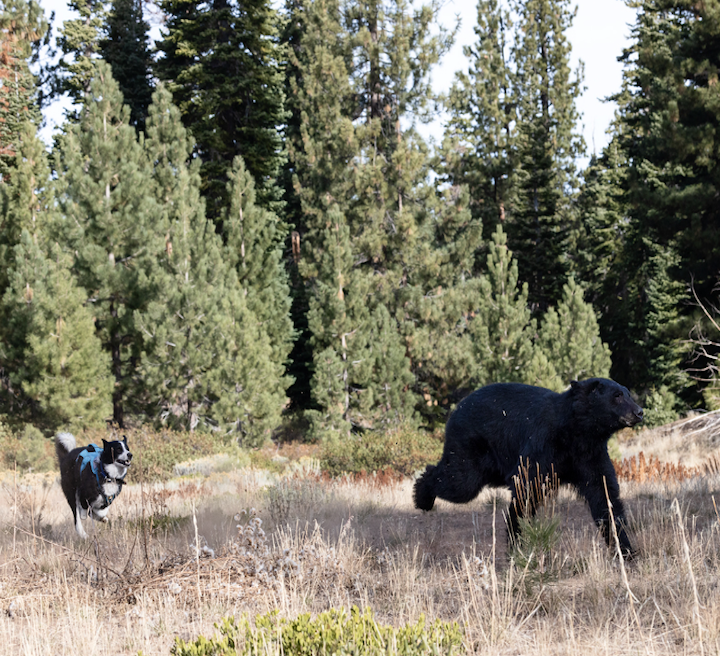
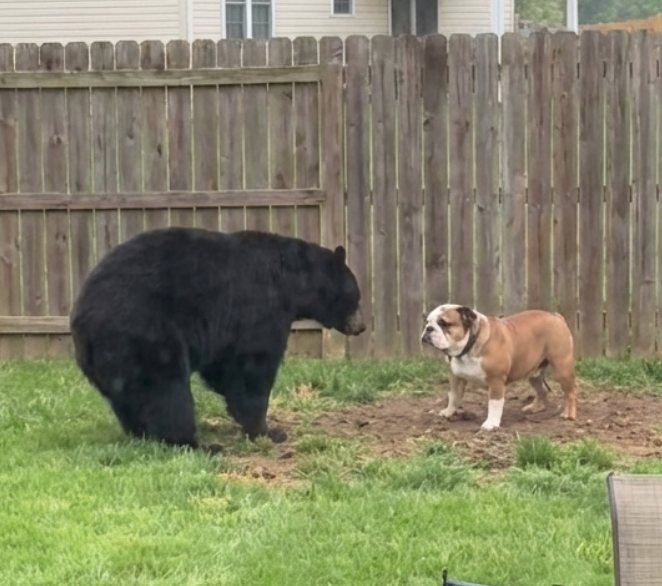

bears in your yard
Please keep your dog in a fenced yard and make sure it is free of attractants.
Although bears tend to be most active during the early morning and early evening hours, they may come around at any time during the day or night. Always check for bears and other wildlife and make noise before letting your pet outside.
When constructing a new fence, leave a wildlife travel corridor of approximately 3 feet or more between your fence line and your neighbours’. Although the initial cost may be higher, as long as you have an attractant free yard, there will be no reason for a bear to break through and damage your fence.
Pets should be fed indoors. If you absolutely need to feed your pet outside, remove the bowl as soon as it is finished and make sure there are no leftovers on the ground.
More than just pets can slide through pet doors. Some bears can squeeze through incredibly small openings, as small as nine inches. Bear cubs and other animals can fit through even smaller openings.
If by chance your dog does get into an encounter with a bear, please do not try to run up and rescue it. You can employ bear spray or a high-powered garden hose from a safe distance.
Walking the Dog
Carry bear spray and know how to use it!
If there is known recent bear activity, it’s best to avoid the area and choose another trail.
Please avoid headsets - it prevents you from hearing animal sounds. Cell phones are distracting.
Avoid walking at times when bears are most active - dawn, dusk or at night.
Knowing the methods of staying safe in bear country, is doubly important when you are walking a dog.
It’s best to keep your dog on leash; retractable leashes are not effective in an emergency.
Stop your dog from barking at, cornering or chasing a bear
Stay alert; watch for bear sign, stop to listen and assess your surroundings - just as your dog does.
Watch your dog’s reactions as you travel. Dogs and bears understand each other’s body language much better than any human could ever hope to do. You will notice that your dog occasionally stops to assess its surroundings, may look up from sniffing, stare in a direction or get excited by picking up on a scent, and sometimes, it will turn to you. Pick up on on your dog’s cues and act accordingly. It is as important to understand your dog’s body language as it is the bear’s if you meet. The situation may be more easily controlled when the dog is near you and on leash. BEAR BODY LANGUAGE
Although a dog can provide a warning system, it is highly unreliable. You may notice a bear before they do, or even walk right by a bear without your dog even noticing.
Dogs do not provide an automatic protection system in a bear encounter. In a recent STUDY spanning 122 years, of bear encounters that resulted in injury, only 64.1% of dogs came to the aid of the owner.
If you and your dog encounter a bear, back up and leave the area.
Spotting a bear is not an automatic photo opportunity; it’s best to be mindful of the situation and turn around and leave.
If your dog gets into an altercation with a bear, do not try to rescue it. You will likely get injured. Use your bear spray.
IF you Walk the Dog OFF LEASH
Although statistically the safest way to walk your dog in bear country is on a leash, there are trails where, at times, it can be safer overall to let your dog off leash, as on steep, gravelly, rocky, rooty and/or slippery terrain. But please, understand the risks and be prepared.
Train your dog
ALWAYS CARRY BEAR SPRAY and know how to use it
Be VERY familiar with how to avoid encounters, with various types of encounters and what to do when you do meet a bear
Be prepared with a leash
Always keep track of your dog’s whereabouts and keep it in sight
Watch your dog’s body language; if its nose is up in the air and/or the dog shows interest in something off in the bush, call the dog to you.
Never follow your dog into the bush if it is chasing something
If your dog encounters a bear while off-leash, your primary goal is to get your dog back and leave the area without triggering a chase.
Stay calm and do not shout or panic
Prepare to use your bear spray
Call your dog back in a firm, commanding voice while standing your ground or slowly backing off
Do not run: Running can trigger the bear’s chase instinct.
When/if the dog returns, immediately put it on a leash, back away slowly and leave.
If the bear charges the dog and gets within range (approx. 9 meters/30 feet), deploy a heavy cloud of bear spray. Do not get between them.
Off-leash dogs may occasionally run back to their owners when frightened, bringing the angry bear directly to them.
You should already have your bear spray prepared
Side-step the path: If your dog is running back with a bear chasing it, quickly step off the trail to the side.
Create a barrier: Put a large tree or boulder between you and the incoming charge if possible.
Use your spray: Create a wall of spray between you and the approaching bear.
Do not allow an off leash dog to harass, chase, or corner a bear!
Although we strongly encourage the public to walk dogs on leash, we are aware that many people do not. The internet is replete with websites publishing comments from hikers who have experienced heroism from their dogs during an encounter with a bear. But you cannot count on it, in fact, often what is perceived as heroism, has actually exacerbated the encounter. Unless the dog is well trained in every manner and circumstance, you have no idea how it will react until you are in the middle of an encounter. Some dogs, may try to protect their owners; however, others will run off. Some may simply stay while turning to warn you; some may try to deter a bear by chasing it for a short distance and soon return, and others may try to run a bear down. The exact same dog can react very differently in different bear encounters. Slow, sick or old dogs can suddenly come alive with enough stimuli and may still chase wildlife. Breed, size and individual dog personalities can play a big role in a dog’s reaction to a bear encounter and can make a difference in the outcome. Bottom line, in most cases, your dog is still harassing the bear and increasing the risk of injury.